
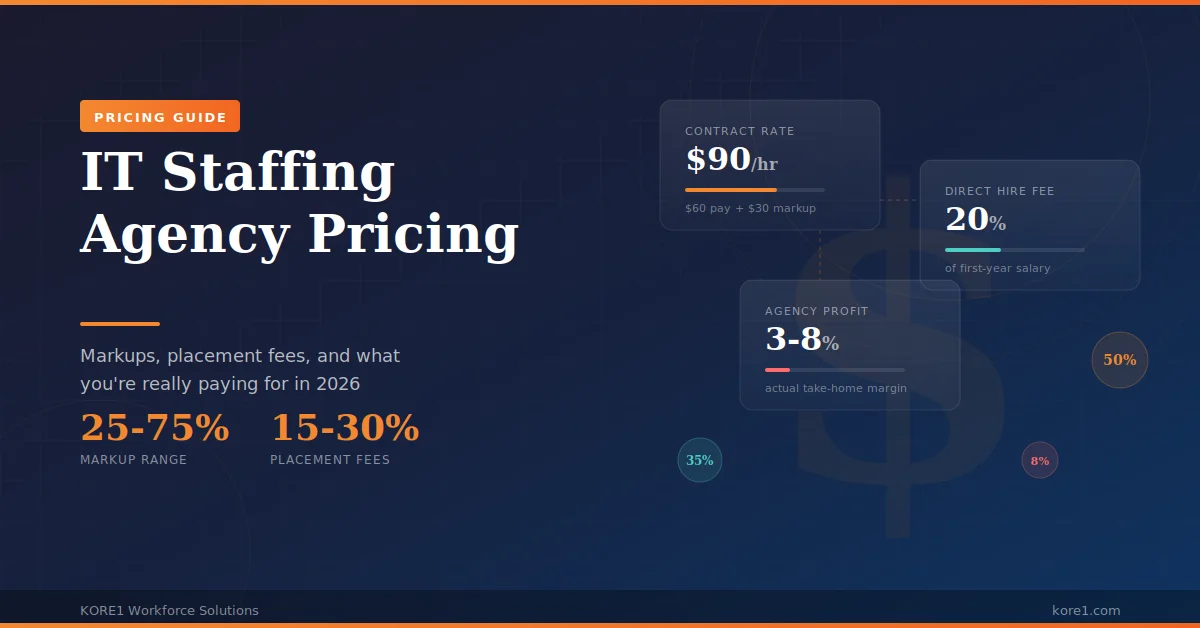
IT staffing agency pricing is the total cost a company pays when using a staffing firm to hire technology professionals, including contractor markups, placement fees, and conversion charges. The pricing model depends on whether you’re hiring contract, direct hire, or contract-to-hire, with markups typically ranging from 25% to 75% and placement fees from 15% to 30% of first-year salary.
You get a bill rate from a recruiter. $95 an hour for a Java developer. And you think… wait. I’d pay this person $110K as a full-time employee. Why am I being quoted nearly double that on an hourly basis?
It’s a fair question. And honestly, most people never get a straight answer.
The staffing industry doesn’t always make pricing easy to understand. Some of that is complexity. Some of it is intentional. But if you’re responsible for hiring IT talent, whether that’s three contractors for a migration project or a permanent DevOps lead, you deserve to know what you’re actually paying for.
SHRM puts the average cost per hire north of $4,000. That number climbs fast for technical roles. And the global staffing market keeps growing at roughly 6% a year according to industry analysts. So there’s a lot of money moving through this system. Yours included.
This guide breaks it all down. Pricing models, what drives costs up, how to tell if you’re getting fair value, and where you might be leaving money on the table.
How IT Staffing Pricing Models Actually Work
There are three main ways staffing agencies structure their fees. Each one fits different situations, and understanding the mechanics will help you compare quotes without getting lost in the weeds.
Contract Staffing and the Hourly Bill Rate
When you bring on a contractor through an agency, you pay an hourly bill rate. That rate includes what the contractor actually earns plus a markup. For IT roles, that markup usually falls between 35% and 50%, though it can stretch from 25% to 75% depending on the role and market conditions.
So what’s baked into that markup? More than you’d think.
The contractor’s hourly pay is the foundation. On top of that, the agency covers payroll taxes (about 7.65% for FICA alone, plus state and federal unemployment taxes), workers’ comp insurance, benefits if they offer them, recruiting costs, background checks, onboarding, and admin overhead. After all that? The agency’s actual profit margin is typically somewhere between 3% and 8%.
Here’s a quick example. Say a contractor’s pay rate is $60/hour and the agency marks up 50%. Your bill rate is $90/hour. That $30 difference sounds like a lot. But most of it goes to statutory costs, insurance, and overhead. The agency’s take-home profit might be $4 to $6 of that.
Direct Hire Placement Fees
For permanent positions, agencies charge a one-time fee based on a percentage of the new hire’s first-year salary. Most IT placements land around 20%, though the range is wider than people realize.
Entry-level IT roles run about 15% to 18%. Mid-level positions like software engineers or network admins typically fall in the 20% to 22% range. Senior and specialized roles can hit 25% to 30%. And for executive-level IT leadership, you’re often looking at retained search models where fees run 25% to 33% of total compensation, not just base salary.
So for a software engineer you’re hiring at $120,000 with a 20% placement fee, you’d pay $24,000 to the agency. That covers their investment in sourcing candidates, vetting them, and presenting you with people who actually fit what you need.
Is $24K a lot? Sure. But consider what it costs you in time, productivity, and opportunity when a role sits open for months.
Contract-to-Hire and Conversion Fees
Contract-to-hire is kind of the best of both worlds, but it comes with its own math.
During the contract period, you pay the regular hourly bill rate. If you decide to bring the contractor on permanently, you pay a conversion fee. That fee usually runs 10% to 25% of the projected first-year salary.
But here’s where it gets interesting. Many agencies offer pro-rated deals where the conversion fee drops based on how long the person has been contracting with you. Some use an hours-credit model where the markup you’ve already paid reduces or eliminates the conversion fee entirely.
The total cost of contract-to-hire is typically higher than going straight to direct hire. But you’re paying for something valuable. You got to watch this person work on your team, in your environment, with your people, before you made a permanent commitment. That trial run is worth real money when you think about the cost of a bad full-time hire.
What Actually Drives IT Staffing Costs Up (or Down)
Bill rates and placement fees don’t exist in a vacuum. Several factors push pricing around, and knowing them gives you leverage when you’re evaluating quotes or negotiating terms.
Skill Scarcity
This one’s pretty straightforward. When there aren’t enough qualified candidates to fill open roles, prices go up. And in IT, that’s been the story for years now. Cybersecurity pros, cloud architects, AI/ML engineers, and DevOps specialists all command premium rates because the talent pool is tight. Agencies have to work harder and spend more to find and secure these candidates, and that cost gets passed along.
Security Clearance Requirements
If your positions require security clearances, buckle up. Cleared IT professionals earn an average of $126,226 annually, and cleared engineering roles average $133,554 according to ClearanceJobs data. TS/SCI and Polygraph requirements shrink the candidate pool dramatically, which means agencies charge significantly more. The timeline to obtain a clearance also plays a role. You can’t rush the process, so agencies need to maintain relationships with an already-cleared talent network, which is expensive.
Location, Location, Location
A cloud engineer in San Francisco costs more than the same role in Charlotte. That’s partly salary expectations and partly the regulatory environment. California’s employment taxes, workers’ comp rates, and compliance requirements are meaningfully different from what an agency faces in Texas. State-level variations show up in your bill rate whether you realize it or not.
Payment Terms and Volume
This is one that catches a lot of companies off guard. If your accounts payable runs Net 60 terms, your staffing agency is financing payroll for two months before they get paid. That has a real cost, and it affects your rates.
On the flip side, volume works in your favor. If you’re filling 10 or 20 roles through one agency, you’ve got leverage. Consistent business justifies thinner margins. And exclusive partnerships where you commit your IT staffing to one firm often unlock the best pricing.
MSP and VMS Platform Fees
Using a Managed Service Provider or Vendor Management System? Those platforms charge their own fees, typically 2% to 5%, and that gets layered into your bill rates. MSPs absolutely provide value through vendor management, compliance tracking, and process standardization. Just know you’re paying for that layer.
Breaking Down Where Your Money Actually Goes
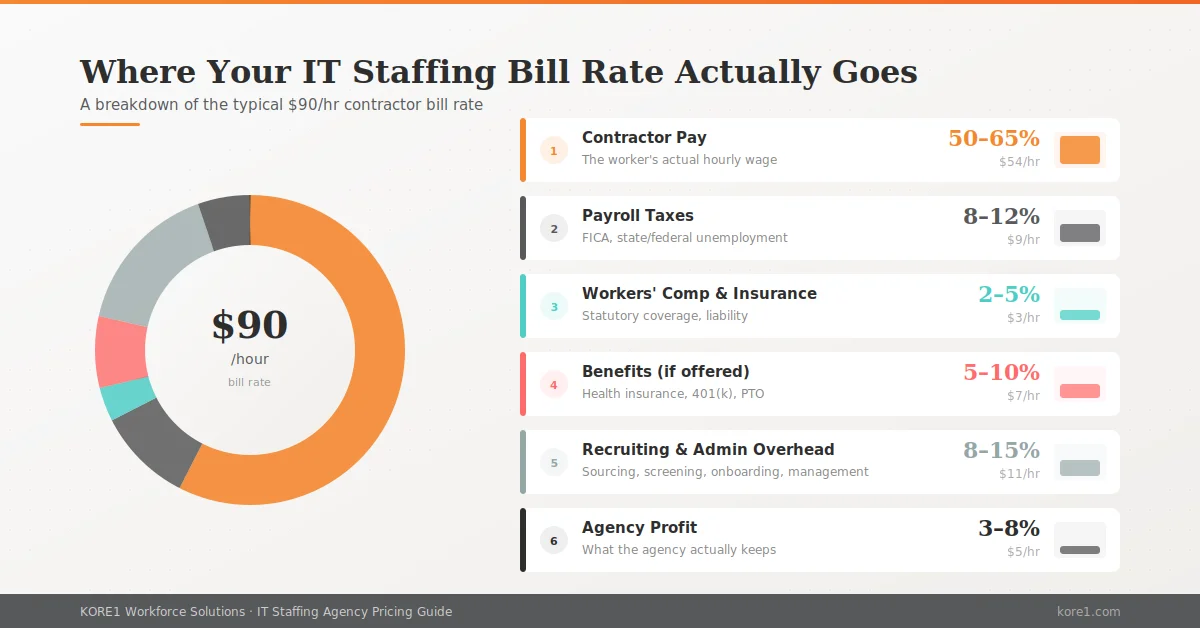
Here’s the thing most people get wrong about staffing. They look at the gap between what the contractor earns and what they’re billed, and assume it’s all profit. It’s not even close.
Direct employer costs, the stuff you’d pay if you hired the person yourself, typically represent 60% to 85% of your total bill rate. These are things like FICA taxes, state and federal unemployment taxes, workers’ compensation, health insurance, and retirement plan contributions.
Take a contractor earning $25/hour in Washington State. Before the agency adds any margin at all, the statutory and benefit costs add 20% to 30% to that base pay. We’re already at $30 to $32/hour and the agency hasn’t taken a dime yet.
The remaining 15% to 30% of the bill rate covers recruiting costs, screening, compliance, account management, and then finally, profit. Which again runs about 3% to 8% on average.
This isn’t to say every agency runs lean. Some don’t. But the idea that staffing firms are pocketing 40% of your bill rate just isn’t how the math works for reputable agencies.
| Bill Rate Component | % of Bill Rate | What It Covers |
|---|---|---|
| Contractor Pay | 50% to 65% | The contractor’s actual hourly wage |
| Payroll Taxes | 8% to 12% | FICA, state/federal unemployment |
| Workers’ Comp and Insurance | 2% to 5% | Statutory coverage, liability insurance |
| Benefits (if offered) | 5% to 10% | Health insurance, 401(k), PTO |
| Recruiting and Admin Overhead | 8% to 15% | Sourcing, screening, onboarding, account management |
| Agency Profit | 3% to 8% | What the agency actually keeps |
Comparing Your Options: Contract vs. Direct Hire vs. Contract-to-Hire
Each model makes financial sense in different situations. Here’s how to think about it without overthinking it.
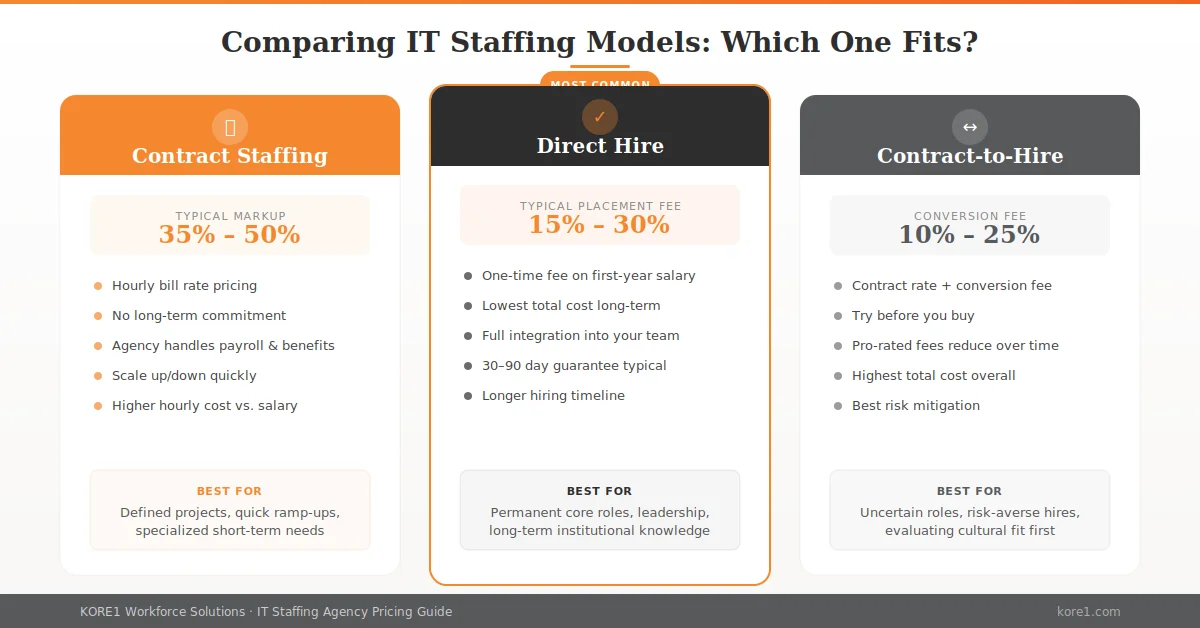
When Contract Staffing Makes Sense
Go contract when you need someone for a defined project, when you need to scale up or down quickly, when you need specialized skills for a limited time, or when you simply can’t wait months for a traditional hire to start. Yes, the hourly rate looks higher than an equivalent salary. But you’re not paying benefits, you don’t have a long-term salary commitment, and you can end the engagement when the work is done.
When Direct Hire Saves You Money
If the role is permanent and central to your operations, direct hire usually wins on total cost. The one-time placement fee, even at 20% to 25%, is often cheaper than paying contract markups for a year or more. Direct hire also makes sense when cultural fit matters, when the role is part of your leadership team, or when you need continuity and institutional knowledge that’s hard to build with rotating contractors.
When Contract-to-Hire Is the Smart Play
Choose this when you’re not 100% sure about the role or the candidate. Maybe you’ve had bad luck with direct hires that didn’t work out. Maybe the position is new and you’re still figuring out what you actually need. Contract-to-hire costs more overall, but that premium is basically insurance against making a $100K+ hiring mistake.
How to Tell If You’re Getting Good Value
Price matters. But it’s not the only thing that matters, and it might not even be the most important thing. Here’s what to actually evaluate.
- Candidate quality. Are the people they send actually qualified? Track your interview-to-offer ratio. If you’re interviewing five candidates to make one offer, the agency isn’t screening well enough, and that costs you time regardless of their rates.
- Speed. How fast do they deliver? A slightly higher rate from an agency that fills roles in two weeks versus six weeks might save you more money than the rate difference costs. Every week a critical IT role sits empty has a productivity cost.
- Replacement guarantees. What happens when a placement doesn’t stick? Most agencies offer 30 to 90 day guarantee periods for direct hires. Read the fine print before you sign.
- Pricing transparency. Can they explain what’s in their rates? Agencies that give you a clear breakdown are almost always a better bet than the ones quoting suspiciously low numbers with vague terms.
- IT specialization. A generalist staffing firm filling your cybersecurity analyst role is a different experience than working with a firm that lives and breathes IT staffing. Specialists know the market, know the talent, and typically fill roles faster with better-fit candidates.
How to Negotiate Staffing Rates Without Hurting Quality
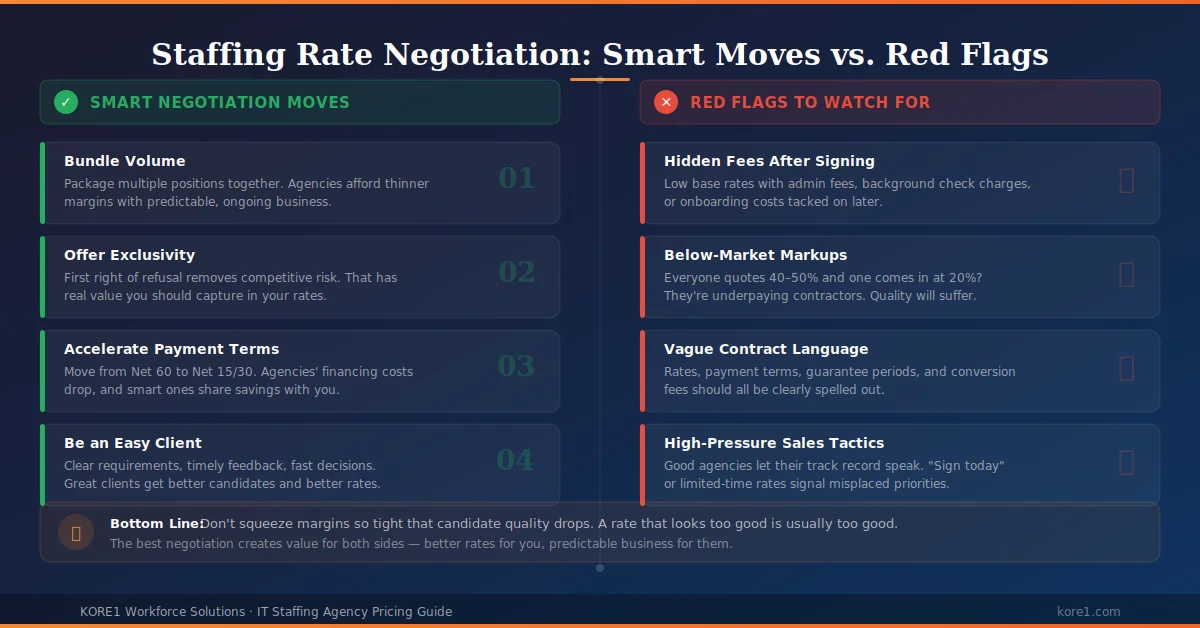
There’s almost always room to negotiate, but the way you negotiate matters as much as the outcome.
- Bring volume to the table. Multiple positions give you leverage. Agencies can afford thinner margins when they have predictable, ongoing business. Don’t be shy about packaging your needs together.
- Offer exclusivity. Telling an agency they have first right of refusal on your IT roles, or committing to exclusivity for a specific period, takes their competitive risk off the table. That has real value to them, and you should capture some of it in your rates.
- Pay faster. If you can move from Net 60 to Net 15 or Net 30, agencies notice. Their financing costs drop, and smart ones will share some of that savings with you.
- Be easy to work with. This one sounds soft, but it’s not. Agencies quietly prioritize clients who give clear job requirements, provide timely candidate feedback, make decisions quickly, and treat contractors well. Being known as a great client gets you better candidates and better rates over time.
- But don’t squeeze too hard. If you beat an agency down to razor-thin margins, something gives. Usually it’s candidate quality. They’ll pay contractors less, which means your top-choice candidates go somewhere else. Or they’ll cut corners on vetting. A rate that looks too good to be true usually is.
Red Flags to Watch For in Staffing Quotes
Not every quote that looks good is good. Here’s what should make you pause.
- Hidden fees showing up after you sign. Some agencies quote low base rates and then tack on admin fees, background check charges, or onboarding costs later. Ask for a complete cost breakdown before you agree to anything.
- Markups that are way below market. If everyone else is quoting 40% to 50% and one agency comes in at 20%, something’s off. They might be underpaying contractors, which means you’ll get whoever is desperate enough to take below-market pay. That’s not a recipe for quality.
- Vague contract language. Your agreement should clearly spell out rates, payment terms, guarantee periods, conversion fees, and termination terms. If it doesn’t, you’ll end up in arguments later.
- High-pressure sales tactics. Good agencies let their track record do the talking. If someone is pushing you to sign today or telling you the rate is only available this week, that’s a red flag about their priorities.
Frequently Asked Questions About IT Staffing Pricing
What is the typical markup for IT staffing agencies?
Most IT staffing agencies apply a markup of 35% to 50% on contractor hourly rates. The markup covers payroll taxes, workers’ comp, benefits, recruiting costs, and the agency’s profit margin, which usually runs between 3% and 8%.
How much do direct hire placement fees cost?
Direct hire fees for IT positions typically range from 15% to 30% of the candidate’s first-year salary. Mid-level roles average around 20%, while senior and executive positions can reach 25% to 33%.
Is contract-to-hire more expensive than direct hire?
The total cost is usually higher because you’re paying contract markups during the trial period plus a conversion fee. But the added cost provides a risk buffer. You get to evaluate a candidate’s real performance before making a permanent commitment.
What’s included in an IT staffing bill rate?
The bill rate includes the contractor’s pay, FICA taxes (7.65%), state and federal unemployment taxes, workers’ compensation insurance, benefits (if provided), recruiting and admin overhead, and the agency’s profit margin.
How can I negotiate better rates with a staffing agency?
The best levers are volume commitments, exclusivity agreements, faster payment terms, and being an easy client to work with. Avoid negotiating so aggressively that the agency can’t attract quality candidates on your behalf.
What’s the difference between a markup and a margin in staffing?
Markup is calculated on top of the contractor’s pay rate. Margin is the percentage of the total bill rate that represents profit. A 50% markup translates to roughly a 33% gross margin, but after all employer costs are covered, net profit margins are typically only 3% to 8%.
Ready to Talk About Your IT Staffing Needs?
Understanding how staffing pricing works puts you in a stronger position, whether you’re comparing agencies, renegotiating an existing contract, or building your first staffing relationship. The right agency balances competitive rates with candidate quality, fast delivery, and real expertise in your technical domain.
At KORE1, we keep our pricing transparent because we know the value speaks for itself. We specialize in IT staffing across contract, direct hire, and contract-to-hire models. Our recruiters place technical talent ranging from software engineers and cybersecurity specialists to data scientists and cloud architects.
Contact KORE1 today to talk through your staffing needs and get clear, honest pricing for your specific situation.