

If you want to hire DevOps engineers in 2026, know this. We placed over a dozen DevOps engineers in Q4 last year. Every one of those searches landed on our desk in a similar way — a hiring manager called after their internal process had stalled for six or more weeks. Sometimes longer. The DevOps market is growing around 20% a year and is on track to blow past $25 billion by 2028. Those numbers feel conservative to me based on what we’re actually seeing on the ground.
So that’s the lens I’m writing through. Not theory. Not a roundup of other people’s blog posts. This is what we’ve picked up from doing this work day in, day out — for companies ranging from 30-person startups to Fortune 500 enterprises. What the market really looks like, what you need to pay, which skills actually separate good candidates from great ones, and (this one stings a little) where most hiring managers quietly lose their best people before an offer ever gets made.
This Isn’t a “Tight Market.” It’s a Structural Problem.
You hear people describe trying to hire a DevOps engineer… they might mention that it’s a tight labor market. That framing misses the point. A tight market implies things will loosen up eventually. This won’t. Not anytime soon. The gap between how many qualified DevOps engineers exist and how many companies desperately need them is structural. It’s baked into the industry.
Cloud adoption crossed 85% among enterprises. Gartner is projecting that 80% of organizations will integrate DevOps platforms into their development toolchains by 2027. Job postings for DevOps engineers? Up roughly 18% year over year since 2020. And the pipeline of people with the right skill mix hasn’t kept up — partly because the role demands this weird cocktail of infrastructure knowledge, automation skills, security awareness, and soft skills that most traditional CS programs never taught as a package.
Recruiters report that about 11% of DevOps positions are genuinely difficult to fill. Not for lack of budget. Because the person you want is already working somewhere, probably already happy there, and isn’t going to move unless something really compelling comes along.
Remote work helped, theoretically. You can now recruit from the entire country instead of one metro area. But here’s the thing nobody mentions — so can every other company. The pool got bigger. The competition got bigger faster. A hiring manager in Omaha is now competing with a hiring manager in San Jose for the same candidate sitting in Austin, and the San Jose company probably has a bigger equity package.
What You Should Actually Be Paying in 2026 When You Hire DevOps Engineers
I talk to hiring managers every single week who are working off salary data from 2022 or 2023. Usually pulled from some free salary tool that hasn’t been updated in a year. Then they’re confused when their offers get rejected. So let me lay out what we’re actually seeing in real placements and cross-referencing against current market data.
| Experience | Base Salary | What We’re Actually Seeing |
|---|---|---|
| Entry-Level, 0–3 yrs | $85K – $110K | Fills faster but quality swings wildly at this tier |
| Mid-Level, 4–6 yrs | $120K – $160K | The bloodbath bracket. Everyone wants this person. |
| Senior, 7+ yrs | $145K – $220K+ | Architects and tech leads blow past $200K regularly |
| DevSecOps, Senior Remote | $165K – $204K | Security skills carry a steep premium right now |
That’s all base salary. Total comp at the large tech companies — once you factor equity, signing bonuses, annual bonuses, and benefits — can tack on another 30 to 50 percent. I’m not saying every company needs to match those numbers. But you need to be in the neighborhood, or at least tell a compelling enough story about growth, impact, and tech stack to close the gap.
Here’s something that catches people off guard: the industries paying the biggest premiums aren’t always the obvious tech hubs. Insurance companies, media and communications firms, financial services, and healthcare organizations are all bidding aggressively for DevOps talent right now. If you’re in one of those industries and using generic “tech salary” surveys to set your ranges, your offers are landing below market. Guaranteed.
Geography still plays a role, though less than it did three years ago. San Francisco, Seattle, New York — premium markets, premium expectations. Remote has narrowed the spread a bit. Not as much as the “remote work will equalize everything” crowd predicted back in 2021, but some.
Skills Worth Hiring For (and the Ones You’re Overthinking)
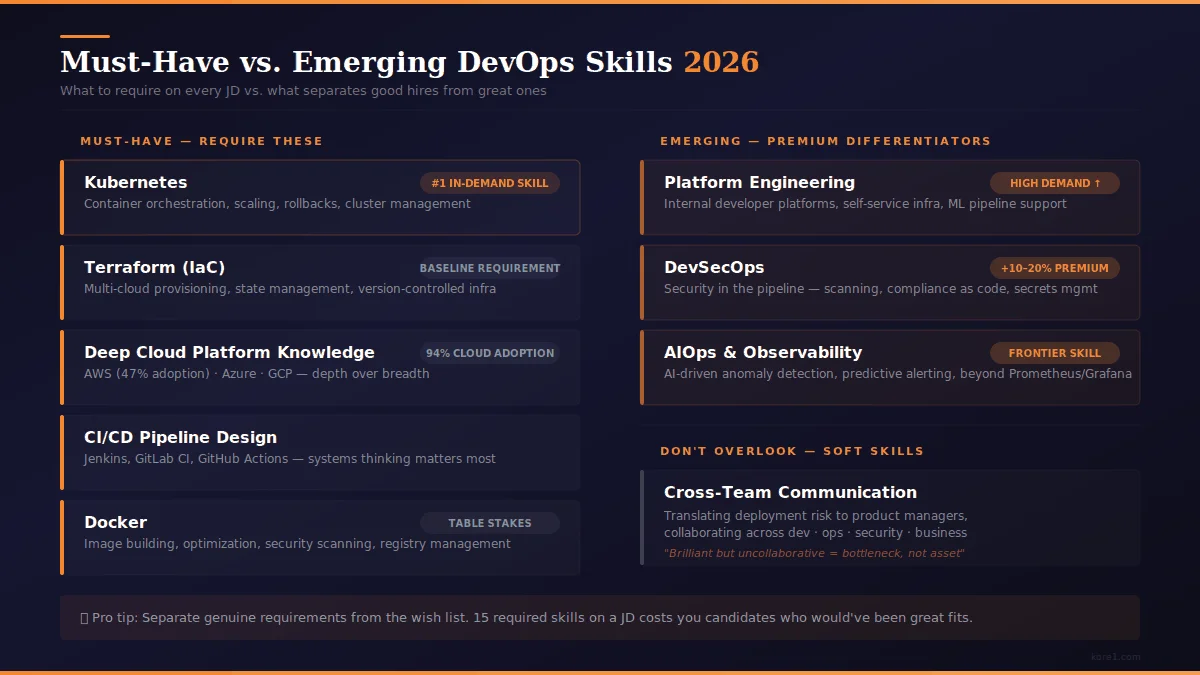
We review job descriptions from clients every week. The average one lists something like 15 required skills. Maybe 5 of those are actually required. The rest are aspirational — and they’re costing you candidates who would’ve been great fits.
Here’s how I’d sort it.
The real requirements
Kubernetes. I’ll say it plainly — if a candidate can’t have a substantive conversation about deploying to Kubernetes, managing scaling, and handling rollbacks, they’re not ready for the roles our clients are filling. It’s the single most in-demand skill for DevOps and SRE positions worldwide, and it has been for several years running now.
Terraform. Infrastructure as Code went from “forward-thinking” to “baseline” faster than most people expected. Terraform’s multi-cloud support makes it arguably the most job-creating tool in the DevOps ecosystem. What you’re looking for: someone who provisions production environments through code and manages infrastructure state through version control. Not someone who learned it in a weekend workshop and added it to LinkedIn.
Deep cloud platform knowledge. And I mean deep — not “I spun up an EC2 instance once.” Over 94% of enterprises run cloud now. Your candidates need real fluency in at least one major platform. AWS still leads at around 47% adoption. Azure has grown in enterprise environments. GCP has its niches. But here’s an opinion I’ll stand behind: genuine depth in one platform is worth more than surface familiarity across all three. Every time.
CI/CD pipeline design. Jenkins, GitLab CI, GitHub Actions, Azure DevOps — the specific tool doesn’t matter nearly as much as the thinking. Can this person architect a pipeline that handles testing, building, deployment, and rollback gracefully? That’s what matters. A competent engineer picks up a new CI/CD tool in a couple weeks. The systems thinking behind it takes years.
Docker. If Kubernetes is the house, Docker is the foundation. Image building, optimization, security scanning, registry management. Table stakes. Every cloud and Kubernetes role assumes it.
What’s getting more important, fast
Platform engineering. It comes up in nearly every conversation I have with engineering leaders lately. The idea: build internal developer platforms — self-service systems where devs can provision infrastructure, deploy, and iterate without filing tickets. It’s DevOps thinking scaled into a product discipline. Companies doing heavy AI and ML engineering work are especially hungry for it, because the infrastructure requirements for ML pipelines are gnarly and can’t depend on manual provisioning.
DevSecOps. Security embedded in the pipeline, not stapled on at the end. Automated scanning, compliance as code, secrets management. Engineers with this skill set are pulling 10 to 20 percent premiums over general DevOps roles. That gap keeps widening.
AIOps and observability. The standard monitoring stack — Prometheus, Grafana, ELK — that’s expected now. The frontier is AI-driven anomaly detection and predictive alerting. Engineers who can bridge traditional observability and emerging AIOps tooling are uncommon and they know it.
The thing nobody wants to evaluate (but should)
Soft skills. Yeah, I know. But the reality is that DevOps only functions when development, operations, security, and the business side are actually coordinating. An engineer who writes gorgeous Terraform modules but can’t translate a deployment risk into language a product manager understands? That person becomes a bottleneck. We’ve watched it happen at multiple client companies — a technically brilliant hire who ends up creating friction instead of reducing it because they can’t collaborate across teams.
We screen for this. It’s one of the biggest reasons clients tell us our candidates outperform people they source off job boards.
Your Process Is Probably the Problem
This section is going to be blunt because it’s the number one reason companies lose DevOps candidates. Not compensation. Not the job description. Not the tech stack. The process itself.
Good DevOps engineers have multiple conversations going at once. Two or three, minimum. And here’s what we’ve watched play out hundreds of times: the company that moves fastest wins. Even when they’re not the highest bidder. Speed signals confidence. Delays signal dysfunction. Candidates notice.
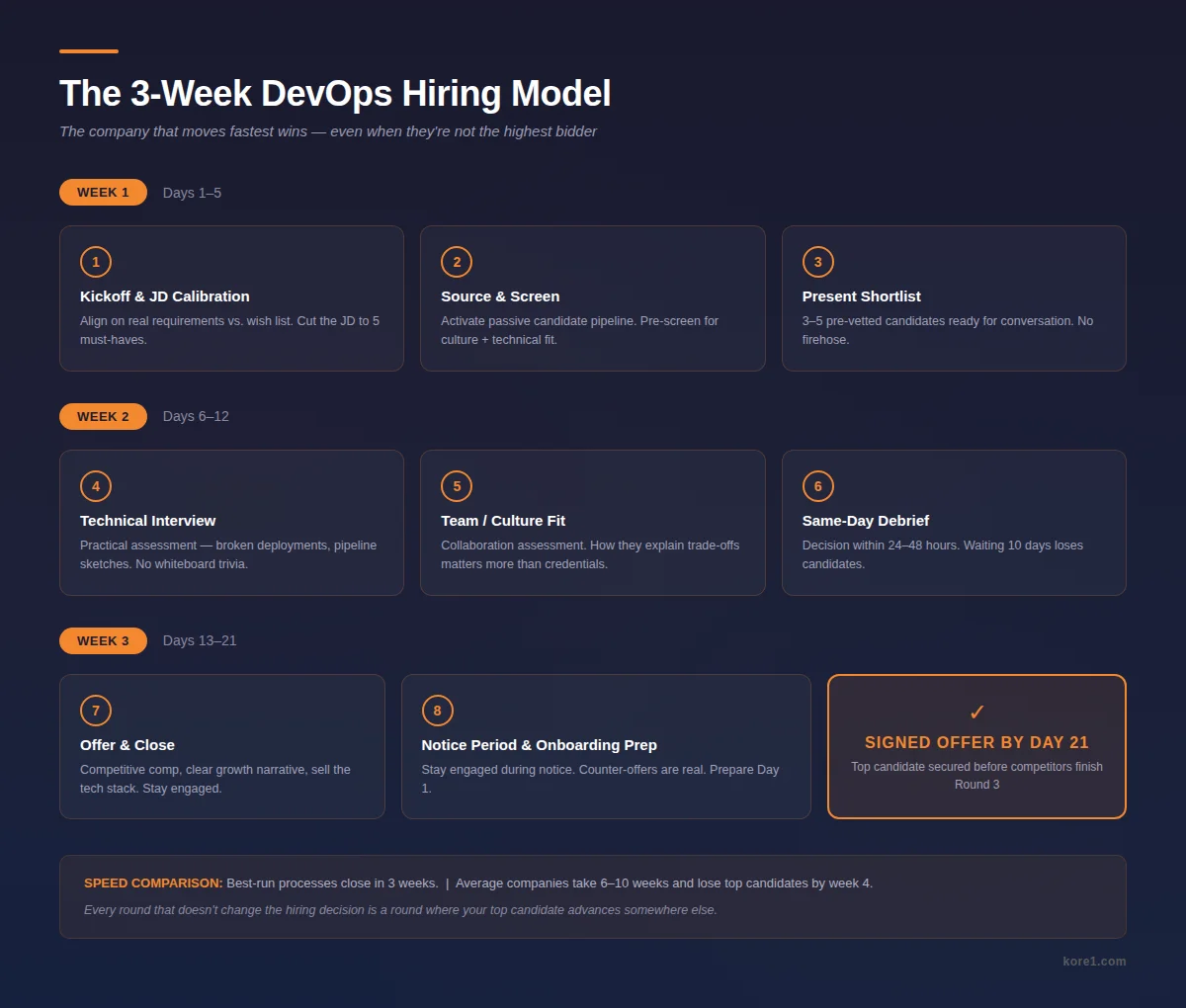
If you can’t get from first conversation to signed offer inside three weeks, something in your process needs to change. Here’s where time usually dies.
Interview rounds that exist out of habit. Five rounds for a mid-level DevOps role. We’ve seen six. I once had a client with seven — and they wondered why they couldn’t close anyone. Every round that doesn’t materially change the hiring decision is a round where your top candidate is advancing somewhere else. Cut mercilessly.
Internal feedback loops measured in weeks. Interview on Tuesday. Debrief the following Monday. Hiring manager travels Wednesday through Friday. Suddenly ten days have passed and the candidate assumes you’re not interested. I can’t overstate how often this happens.
Whiteboard exercises for infrastructure roles. Algorithm puzzles for a DevOps job? It makes no sense. Give candidates something practical — a broken deployment to debug, a pipeline to sketch, an infrastructure diagram to critique. Test the actual work.
Forgetting to sell. This is subtle. You’re not the only one evaluating fit. The candidate is evaluating you right back. What’s the stack look like? Is it modern or are they inheriting a decade of tech debt nobody wants to address? What does growth look like? Will they build things or just keep lights on? The companies that close top candidates are the ones who answer these questions convincingly during the interview — not after the offer goes out.
Contract, Contract-to-Hire, or Direct: Choosing the Right Path
People overthink this. Match the model to the situation.
You have a cloud migration deadline in ten weeks and no one on the bench? Contract. Bring in experienced engineers who start within days and ship the project. No six-week hiring gauntlet, no negotiating start dates around two-week notice periods at their current job.
You think you need a permanent hire but you’re not 100% sure about team fit — or honestly, you’re not even sure the role is permanent yet? Contract-to-hire. You get weeks or months of real performance data instead of relying on a few hours of interviews. Both sides can walk if it’s wrong. Both can commit if it’s right. It’s the lowest-risk path for hard-to-fill roles.
Building a core team for the long haul? Direct hire. But even then, partnering with an IT staffing firm that knows DevOps can compress the search by weeks. We handle sourcing and screening so your team only sees candidates who are actually worth talking to. Not the 200-application firehose you get from a job board.
When a Staffing Partner Adds Value (and When They Don’t)
Bias disclosure: I work at a staffing firm. I’ll try to be fair.
Tight timeline. This is the most obvious one. If you need someone onboarded in weeks and you don’t have a warm pipeline, a staffing partner with a built-out DevOps network gets you there faster. That’s not marketing — it’s arithmetic. We’ve already done the sourcing legwork.
Niche skill combinations. Senior Kubernetes architect, DevSecOps experience, Terraform multi-cloud, and they need to pass a security clearance. That person is not scrolling Indeed. They’re passive — employed, reasonably content, but open if the right thing comes along. Specialized recruiters already know these people because they’ve spent years cultivating the relationships.
Parallel hiring. Three or four DevOps engineers in one quarter? Running those searches simultaneously without a dedicated recruiting function grinds everyone to a halt. We absorb that workload so your internal team doesn’t burn out.
Honest market feedback. “Your comp is 15% below market for this role.” “Your job description is scaring off mid-levels because it reads like a staff-level req.” “Candidates are dropping after round three because the take-home assessment takes eight hours.” A good partner tells you the stuff that’s hard to see from inside your own process. That intelligence makes every hire better, including the ones you find without us.
When you probably don’t need us: you have a solid internal recruiting team, no real urgency, and you’re hiring a straightforward mid-level role in a major market. Save the money. But if the req has been open eight weeks with a thin pipeline… well, that’s typically when we get the call anyway.
Last thing here — and I mean this sincerely. Not all staffing firms are the same. A generalist agency that fills DevOps roles alongside office managers and warehouse staff will dump a stack of resumes on your desk and call it service. A partner that understands the actual difference between someone who lists Kubernetes on their resume and someone who’s architected production clusters serving real traffic at scale — totally different conversation. Choose accordingly.
Mistakes We See Over and Over (and Over) When People Hire DevOps Engineers
The sysadmin job description. DevOps is not system administration. I know that sounds obvious, but I see it constantly — JDs that read like a list of servers to babysit and patches to apply. If that’s what you publish, you’ll attract sysadmins and repel the automation-focused, infrastructure-as-code people you need. Words matter. Framing matters.
The exact-stack requirement. “Must know GitHub Actions.” Candidate uses GitLab CI and has for five years. Candidate gets screened out. This happens more than you’d think. A strong engineer learns a new CI/CD tool in two or three weeks. But systems thinking, the instinct for how to debug a complex distributed system under pressure, the ability to design infrastructure that actually scales — those things take years. You can’t sprint them in onboarding.
Radio silence between rounds. Nothing kills candidate interest faster. Two weeks without an update after a strong technical screen? They’ve moved on emotionally. They may have accepted something else. Or they’re still technically in your pipeline, but now they’re irritated, and that colors every interaction going forward. Set response timelines at the start. Then — this is the important part — actually hit them.
Skipping the collaboration assessment. DevOps exists to break down silos. If your interview loop is entirely technical — no evaluation of how this person communicates, handles disagreement, explains trade-offs to non-technical stakeholders — you’ll miss critical information. The engineers who create the most damage aren’t the ones with weak technical skills. They’re the ones who can’t work with other humans.
Unicorn hunting. “Must be expert in AWS, Azure, AND GCP. Must know Kubernetes, Docker, Terraform, Ansible, Puppet, Jenkins, and three programming languages. 8+ years required.” (In a tool that’s existed for five.) I’ve barely exaggerated this. These JDs sit open for months. Be honest about what you actually need. Separate genuine requirements from the wish list. You’ll fill faster and probably hire better.
Keeping Them Once You Hire DevOps Engineers
Quick section on retention because it connects directly to everything above.
The number one reason DevOps engineers leave within 18 months, from what we’ve seen across our placements: the job wasn’t what they were told. They signed up to build cloud-native infrastructure. They ended up patching a legacy deployment system nobody wants to prioritize replacing. Or they were hired as “senior” but have zero architectural autonomy — just an inflated title on a ticket queue.
Be honest during hiring about what the work actually looks like. The exciting parts and the tedious parts. Candidates respect that. What they don’t respect — and what makes them start returning recruiter calls six months in — is bait and switch.
Structure your team with layers. Senior architects setting direction. Mid-levels carrying the daily workload. Juniors growing into bigger responsibilities over time. That creates organic career paths and prevents a single departure from gutting your institutional knowledge.
Fund their development. Certifications, conferences, hack weeks, dedicated learning time. DevOps moves fast. New services, new patterns, new tools every quarter. Engineers who feel like they’re falling behind get anxious. Anxious engineers pick up the phone when recruiters call. Investing in growth is cheaper than backfilling the role.
And — stay plugged into the market between hires. Build recruiter relationships before you’re desperate. Maintain visibility in DevOps communities. The absolute worst time to start a partnership with a staffing firm is when you’re already behind on a critical hire and panicking. By then, everyone else has a head start on the same candidates.

Frequently Asked Questions
How much does it cost to hire a DevOps engineer in 2026?
Base salaries run from about $85K at entry level up past $220K for senior engineers and architects. Add equity, bonuses, and benefits at larger companies and total comp goes considerably higher. DevSecOps specialists and platform engineers are pulling 10 to 20 percent premiums over standard DevOps roles — that gap has held steady for about two years now and shows no sign of closing.
What’s the difference between DevOps and DevSecOps?
DevOps is about getting code from a developer’s laptop into production faster and more reliably — automation, CI/CD pipelines, infrastructure as code. DevSecOps takes that same pipeline and weaves security into it. Automated vulnerability scanning, compliance checks, secrets management. Instead of security being the team that slows everything down at the end, it’s embedded from the start. The engineers who can do both well are harder to find, which is why they cost more.
How long should the hiring process take?
The best-run processes we see close inside three weeks — first conversation to signed offer. Plenty of companies take six to ten weeks and don’t understand why their top candidates keep ghosting them somewhere around week four. Working with a specialized staffing partner shaves time off significantly, particularly for senior or unusual skill combinations.
Full-time or contract — which is better for DevOps?
Depends entirely on the situation. Full-time makes sense when you’re building a core infrastructure team for the long run. Contract is usually the smarter play for time-bound projects — a cloud migration, a platform build, a scaling push. Contract-to-hire is the middle path when you want real on-the-job evaluation before committing. We use all three models depending on what the client actually needs.
Do certifications matter?
They’re useful signals. The three that carry the most weight: AWS Certified DevOps Engineer, Certified Kubernetes Administrator (CKA), and HashiCorp Certified Terraform Associate. That said — and I can’t stress this enough — we’ve placed outstanding engineers who hold zero certifications and passed on certified candidates who couldn’t troubleshoot their way out of a basic deployment issue. Real-world experience wins.
Why is DevOps hiring so difficult?
Because the role sits at the intersection of too many disciplines. Cloud infrastructure, containerization, CI/CD, automation, scripting, security, monitoring — and on top of all that, the communication skills to work across dev, ops, security, and business teams. Very few people have the full package. The ones who do have figured out what they’re worth, and they’re not hurting for options.
Let’s Talk
If you’ve read this far, something in here probably hit close to home. Maybe your DevOps req has been open for weeks with a thin pipeline. Maybe you’re kicking off a cloud project and needed engineers yesterday. Maybe your process is fine but you just need more qualified candidates in the funnel.
Whatever it is — reach out to us. Our team at KORE1 places DevOps and cloud infrastructure engineers every week. We know the market, we know the candidates, and we don’t pad your pipeline with unqualified resumes to look busy.