
Hiring a cloud engineer right now feels a lot like trying to buy a house in 2021. Everything moves fast, the good ones get snatched up before you blink, and you’re probably going to pay more than you planned. That’s the reality of the cloud engineering talent market in 2026, and it’s not slowing down anytime soon.
We put this guide together because we talk to hiring managers every single week who are dealing with this exact problem. They need cloud talent. They’re not sure what to pay. They don’t know which skills to prioritize. And by the time they figure it all out, the candidate they liked has already accepted another offer.
So here’s what we’re going to cover. Real salary numbers across AWS, Azure, and GCP. The skills that actually separate good cloud engineers from great ones. What’s working (and what’s not) when it comes to the hiring process itself. And when it makes sense to bring in a cloud engineer staffing agency to help you compete.
What’s Happening in the Cloud Talent Market Right Now
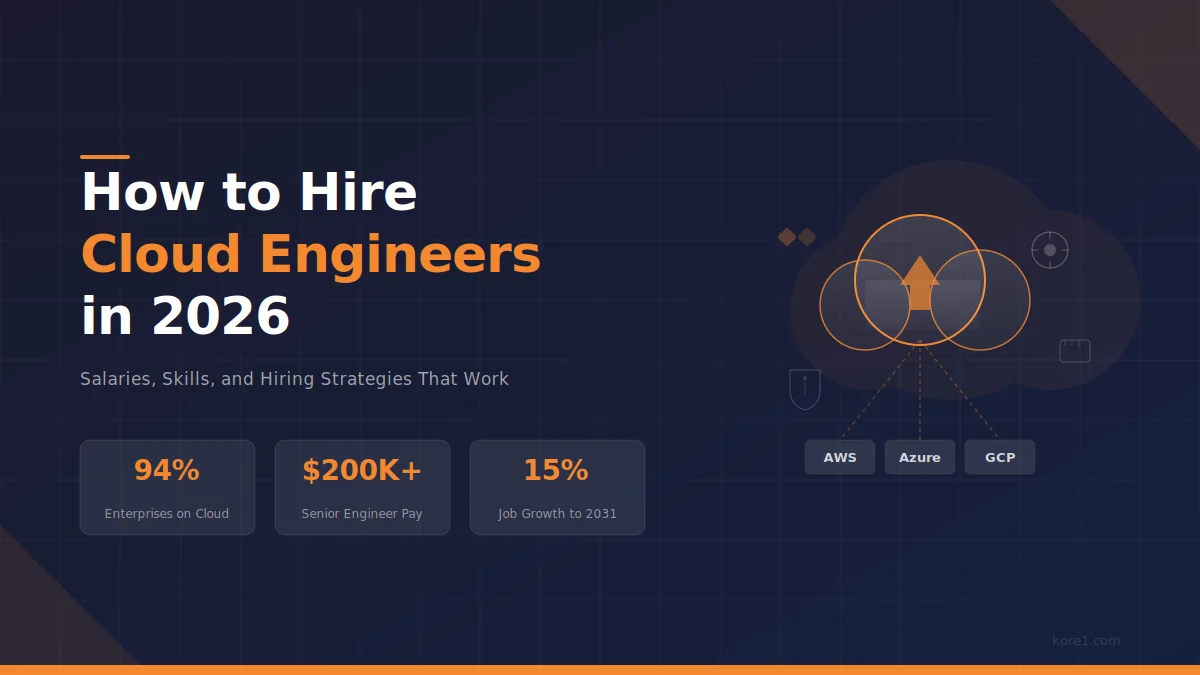
The numbers tell the story pretty clearly. Over 94% of enterprises are running cloud services today. Cloud hosting handles about 72% of all workloads worldwide. And 78% of IT decision-makers have made cloud their primary infrastructure play.
All of that adoption created a massive talent gap that hasn’t closed. About 77% of employers reported difficulty hiring skilled tech candidates over the past year, and cloud roles are consistently near the top of that list. The Bureau of Labor Statistics projects cloud computing positions will grow roughly 15% through 2031, which is significantly above the national average.
But here’s the part that a lot of people miss. AI made everything harder.
Companies that launched AI initiatives in 2024 and 2025 are now discovering their cloud infrastructure can’t handle the load. AI workloads demand heavy compute resources, reliable data pipelines, and engineers who know how to build all of that without the monthly AWS bill spiraling out of control. So now you’ve got traditional cloud demand plus this whole new wave of AI-driven infrastructure needs competing for the same pool of engineers.
It’s a tough spot to be in if you’re hiring. But it’s solvable if you know what you’re doing.
Cloud Engineer Salaries in 2026 (What You’ll Actually Need to Pay)
We’re going to be direct here because outdated salary ranges are one of the biggest reasons companies lose candidates early in the process. If your budget was set based on 2023 data, you need to update it.
Salary Ranges by Experience Level
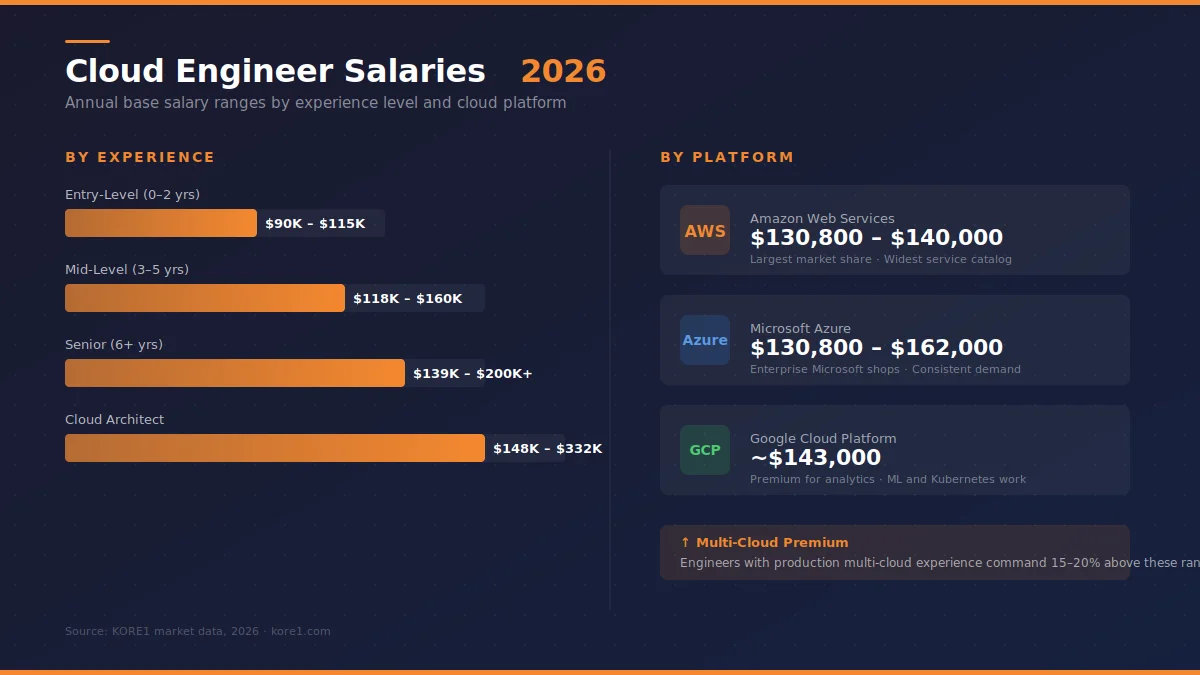
Entry-level cloud engineers (0 to 2 years) are pulling $90,000 to $115,000 annually. Two years ago that range was about $10K lower. The floor keeps rising because even junior engineers have options.
Mid-level cloud engineers (3 to 5 years) earn between $118,000 and $160,000. This is the sweet spot where most companies are competing, and it’s also where bidding wars happen most often.
Senior cloud engineers (6+ years) command $139,000 to $200,000+, depending on specialization and location. Some senior roles in major metros go well beyond $200K when you factor in total comp.
Cloud architects sit at $148,000 to $332,000. That’s a huge range, but architecture roles vary wildly in scope. A cloud architect at a mid-size company looks very different from one designing multi-region infrastructure for a Fortune 500.
What Each Platform Pays
| Platform | Median Salary Range | Why It Commands That Rate |
|---|---|---|
| AWS | $130,800 to $140,000 | Largest market share, widest service catalog |
| Azure | $130,800 to $162,000 | Enterprise Microsoft shops drive consistent demand |
| GCP | ~$143,000 | Premium for analytics, ML, and Kubernetes work |
A couple things worth calling out. Remote work changed the geography equation. Engineers in mid-size cities are earning close to what used to be reserved for San Francisco and Seattle. That’s great news if you’re an employer outside a tech hub because it means you can access talent that wasn’t available to you five years ago.
And if a candidate has real multi-cloud experience (not just buzzword familiarity, but actual production work across two or more providers), expect to pay 15 to 20% above these ranges. Those people are rare and they know it.
The Skills You Should Actually Be Screening For
Cloud engineering has evolved past the point where someone who knows how to launch an EC2 instance qualifies as a strong hire. The role today is broader and more complex. Here’s what to prioritize.
The Non-Negotiables
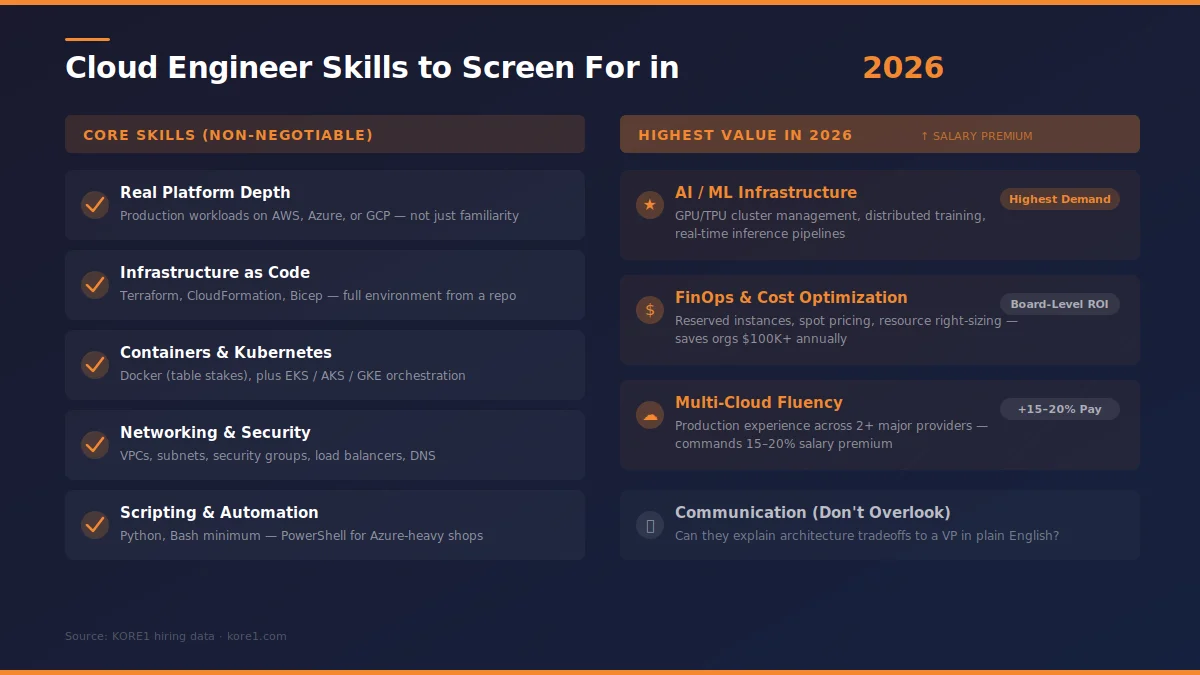
- Real platform depth. Not just familiarity. You want someone who has designed, built, and troubleshot production workloads on AWS, Azure, or GCP. Ask them about the worst outage they dealt with. That tells you more than any certification.
- Infrastructure as Code. Terraform is the gold standard because it works across providers. But you’ll also see engineers who are strong with CloudFormation, Azure Bicep, or Google’s Deployment Manager. The key question: can they provision an entire environment from a repo? If yes, good sign.
- Containers and Kubernetes. Docker knowledge is table stakes at this point. Kubernetes experience is where things get interesting, especially with managed services like EKS, AKS, and GKE. If you’re building out AI and ML engineering capabilities, container orchestration becomes critical for model deployment.
- Networking and security fundamentals. VPCs, subnets, security groups, load balancers, DNS configuration. An engineer who can’t navigate this stuff confidently is going to create bottlenecks (and possibly security vulnerabilities) on your team.
- Scripting chops. Python and Bash at minimum. PowerShell if you’re running a lot of Azure. The difference between a good cloud engineer and a great one often comes down to their ability to automate the boring stuff.
What’s Getting More Valuable in 2026
- AI/ML infrastructure experience. GPU and TPU cluster management, distributed training setups, real-time inference pipelines. This is where the highest salary premiums are right now. If someone has this skill set and also understands cost optimization, they’re going to have five offers by next Friday.
- FinOps skills. Cloud spending is becoming a board-level conversation at a lot of companies. Engineers who understand reserved instance strategies, spot pricing, and resource right-sizing can literally save organizations hundreds of thousands of dollars a year. That’s a tangible ROI that gets noticed.
- Multi-cloud fluency. The days of picking one provider and sticking with it are mostly over. Engineers who can work across AWS, Azure, GCP, and on-prem environments without missing a beat have serious negotiating power.
One more thing that doesn’t show up on a technical skills matrix but matters a lot. Communication. Cloud engineers interact with developers, security teams, product managers, and executives. If someone can architect a beautiful system but can’t explain it to a VP in plain English, you’re going to have friction.
Certifications: Helpful or Overhyped?
Bit of both, honestly.
Certifications prove that someone studied the material and passed a test. That’s worth something. We’ve seen plenty of certified engineers who are genuinely excellent. But we’ve also seen people with three AWS certs who freeze up the second something breaks in production. So don’t treat certifications as a shortcut for evaluating actual capability.
That said, these are the ones our recruiters see making the biggest difference in candidate competitiveness and salary offers.
- AWS certs that matter: Solutions Architect (both Associate and Professional), DevOps Engineer, Security Specialty
- Azure certs that matter: Solutions Architect Expert (AZ-305), Administrator (AZ-104), Security Engineer (AZ-500)
- GCP certs that matter: Professional Cloud Architect, Professional Data Engineer, Professional Cloud DevOps Engineer
Professional and specialty-level certs do tend to come with immediate salary bumps. We see that pretty consistently. But if you’re hiring a senior engineer, their project portfolio and references are going to tell you a lot more than their cert count.
What’s Actually Working in Cloud Engineer Hiring
We’ve watched hundreds of cloud engineering searches play out over the past couple years. Some go smoothly. Many don’t. Here’s what separates the companies that close great hires from the ones that keep losing candidates.
Speed wins. Period.
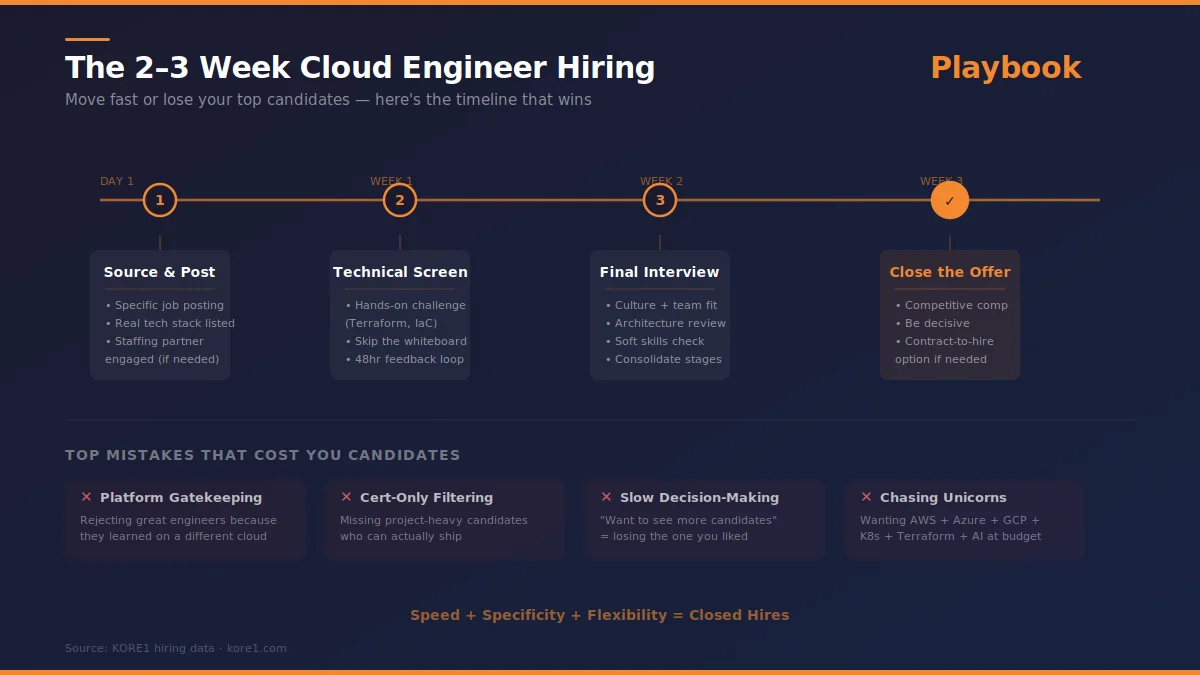
Two to three weeks from first screen to offer. That’s the window. Any longer and you’re competing against companies that moved faster. We know that’s aggressive for some organizations, especially ones with multi-stage approval processes. But the data is pretty clear. Companies that streamline their interview process close better candidates at higher acceptance rates.
Try consolidating assessment stages where possible. Give candidates feedback within 48 hours. And seriously consider replacing theoretical whiteboard exercises with practical, hands-on assessments. A take-home Terraform challenge tells you way more about someone’s ability than asking them to reverse a binary tree on a whiteboard.
Tell candidates what they’ll actually be working on
Vague job postings attract vague candidates. Be specific about your cloud platforms, your architecture, the projects they’ll touch. If you’re mid-migration or building something new, say so. That’s actually a selling point for good engineers. They want to build things, not just maintain them.
Be flexible on employment models
Contract and contract-to-hire have become mainstream for cloud roles. These models let you bring someone in quickly, evaluate their work in your actual environment, and convert to full-time if the fit is right. For specialized projects like migrations or multi-cloud implementations, this approach is often smarter than trying to find and close a permanent hire under time pressure.
Working with a specialized IT staffing partner makes these flexible models a lot easier to execute because they handle the sourcing, vetting, and logistics.
When a Cloud Engineer Staffing Agency Makes Sense (and When It Doesn’t)
Let’s be real. You don’t need a staffing firm for every cloud hire. If you have a strong internal recruiting team, good employer brand recognition, and plenty of time, you can probably fill standard roles on your own.
But there are specific situations where a specialized partner pays for itself pretty quickly.
- Migration projects with hard deadlines. You need three cloud engineers who’ve done AWS-to-Azure migrations before, and you need them in four weeks. Good luck sourcing that through LinkedIn job posts. A staffing partner with an existing network of migration specialists can deliver.
- Niche platform skills. Kubernetes security. Advanced GCP data engineering. FinOps specialization. These aren’t skills you find on every resume. Specialized recruiters have relationships with passive candidates who have exactly these backgrounds.
- You need to scale fast. Business is growing. New projects are stacking up. Your internal recruiting team is already stretched thin. A staffing firm lets you hire multiple qualified engineers simultaneously without burning out your own people.
- You need market intel. What are your competitors paying? What benefits are candidates expecting? What’s the realistic timeline for a senior GCP architect in your market? A good partner gives you that data so you can calibrate your approach before wasting time on searches that won’t close.
When evaluating agencies, look past the sales pitch. Ask them what cloud platforms they’ve staffed for recently. Ask them to explain the difference between a cloud engineer and a DevOps engineer. If they can’t answer confidently, keep looking. You want a firm that actually understands the technical landscape, not one that’s Googling your requirements after the call.
Mistakes We See Over and Over Again
These come up in probably half the searches we work on. All of them are fixable.
- Rejecting candidates who learned on a different platform. An engineer with four years of deep AWS experience can get productive on Azure faster than most people expect. Cloud fundamentals transfer. You’re limiting yourself unnecessarily if your job req says “AWS only” when the role is 70% platform-agnostic work anyway.
- Treating certifications like a hard filter. We talked about this already, but it bears repeating. A cert-heavy, experience-light candidate is a risk. A no-cert, project-heavy candidate is often a gem. Screen for both. Weight them appropriately.
- Forgetting about soft skills entirely. Cloud engineers don’t work in a vacuum. They’re on calls with developers, sitting in architecture reviews with leadership, explaining tradeoffs to project managers. Technical brilliance without communication ability creates organizational drag.
- Dragging out the decision. “We liked them but we want to see a few more candidates first.” We hear that constantly. And then two weeks later, the candidate they liked is gone. In this market, decisiveness is a competitive advantage.
- Chasing unicorns. The person who’s an expert in AWS, Azure, GCP, Kubernetes, Terraform, security, FinOps, and AI infrastructure at your budget? That person is either retired in Bali or doesn’t exist. Figure out what you truly need versus what would be nice to have. Then build a job description around reality.
Keeping Cloud Engineers Once You’ve Hired Them
Retention is the part that doesn’t get enough attention. You just spent weeks (maybe months) finding and hiring a great cloud engineer. Now what?
The good ones want to keep learning. Cloud platforms push new services and capabilities constantly, and the engineers who thrive in this space are the ones who are always picking up something new. If your company supports certification programs, sends people to re:Invent or Google Next, or even just gives engineers dedicated time to experiment with new tools, you’ll keep people longer. It sounds simple. A lot of companies still don’t do it.
Career paths matter too. If someone can’t see a clear trajectory from where they are now to where they want to be in three years, they’ll find a company where they can. Talk to your engineers about growth. Not just during annual reviews, but regularly.
Team composition is another factor people underestimate. You want a mix of deep platform specialists and versatile generalists. Senior architects who can mentor alongside mid-level engineers who execute. When that balance is right, knowledge gets shared, people feel supported, and you don’t end up in a situation where one person leaving takes half your institutional knowledge with them.
Even when you’re not actively hiring, stay connected to the market. Build relationships with recruiters. Keep your employer brand visible. The companies that treat recruiting as an always-on function (even during hiring freezes) find it dramatically easier to fill roles when the need comes up.
What to Do Next
Cloud engineering hiring in 2026 comes down to three things. Pay competitively, move fast, and know when to bring in help. The companies that get all three right are the ones building the strongest teams.
At KORE1, cloud and infrastructure staffing is a core part of what we do. Our recruiters know the difference between a CloudFormation template and a Terraform module, and they know how to evaluate candidates across AWS, Azure, and GCP at a technical level. We work as an extension of your team, not a resume factory.
Talk to a KORE1 recruiter today and let’s figure out the right approach for your cloud hiring needs.
Frequently Asked Questions
What does a cloud engineer cost in 2026?
It depends on experience and platform. Entry-level cloud engineers earn $90,000 to $115,000. Mid-level sits at $118,000 to $160,000. Senior engineers pull $139,000 to $200,000+. Platform matters too. AWS engineers average $130,800 to $140,000 at the median, Azure runs $130,800 to $162,000, and GCP comes in around $143,000. Cloud architects can go as high as $332,000 depending on the scope of the role.
Which cloud engineer skills are hardest to find?
AI/ML infrastructure skills top the list right now. Engineers who can manage GPU clusters and build inference pipelines are incredibly scarce. FinOps expertise is also hard to source because it’s still a relatively new specialization. And real multi-cloud experience (not just listing three logos on a resume) remains difficult to find and verify.
How fast should our interview process be?
Two to three weeks from first conversation to offer. That’s the target. Companies that hit that window see significantly higher acceptance rates. Every extra week you add to the process increases the odds of losing your top candidate to a faster-moving competitor.
Are cloud certifications worth requiring?
They’re worth considering, but not worth requiring as a hard filter. Certifications validate knowledge and show initiative. They don’t guarantee someone can troubleshoot a production outage at 2am. Pair cert requirements with practical assessments and reference checks for a complete picture.
When should we bring in a staffing agency for cloud roles?
When you have time-sensitive projects, need niche expertise that’s hard to find through job boards, want to scale your team quickly, or need market data on compensation and candidate expectations. A specialized cloud engineer staffing agency brings pre-vetted candidates and industry knowledge that speeds up the entire process.